Digital laws of the federal states
Efficient implementation of the e-government and information security laws of the German federal states with Versio.io
In a nutshellRequest demoStart free trialWhat are the digital laws of the federal states?
Why do the federal states need their own laws?
The digital laws of the 16 federal states at a glance
| Federal state | E-government or digital law | Information security and NIS2 implementation |
|---|---|---|
| Baden-Württemberg | E-Government Act Baden-Württemberg (EGovG BW, 2015) | Cyber Security Act (CSG, 2021) with the Cyber Security Agency Baden-Württemberg (CSBW); NIS2 implemented by the Cyber Security Ordinance (CSVO, in force since 24 April 2025) |
| Bavaria | Bavarian Digital Act (BayDiG, 2022) | IT security in Part 3 of the BayDiG (Art. 41 to 49c) with the Bavarian State Office for Information Security (LSI); NIS2 requirements in Art. 49a to 49c (2024) |
| Berlin | E-Government Act Berlin (EGovG Bln, 2016) | ISMS according to BSI standards, Berlin-CERT and reporting obligation (§ 23 EGovG Bln); NIS2 implementation for the state administration in preparation |
| Brandenburg | Brandenburg E-Government Act (BbgEGovG, 2018) | Security concepts, CERT and reporting obligation for security incidents (§ 16 BbgEGovG) |
| Bremen | Act on the Promotion of Electronic Administration in Bremen (EGovG BR, 2018) | NIS2 implemented by administrative regulation (VV NIS2Ums FHB, 2025); a comprehensive Bremen Cyber Security Act is planned |
| Hamburg | Hamburg Administrative Digitalisation Act (HmbVwDiG, 2024) | No separate information security law yet; one is planned to meet the NIS2 requirements |
| Hesse | Hessian E-Government Act (HEGovG, 2018) | Hessian IT Security Act (HITSiG, 2023) with the Hessen CyberCompetenceCenter (Hessen3C); NIS2 implemented by a joint decree (NIS2 Joint Decree, StAnz. 2024, p. 1215) |
| Mecklenburg-Western Pomerania | E-Government Act Mecklenburg-Western Pomerania (EGovG M-V, 2016) | Information Security Act (ISichG M-V, 2026): BSI IT-Grundschutz, security operations centres and reporting obligations for state and municipal bodies |
| Lower Saxony | Lower Saxony Act on Digital Administration and Information Security (NDIG, 2019) | Information security in Part 3 of the NDIG (§§ 13 to 30); NIS2 implemented by decree (NIS2UmsRdErl, 2024) |
| North Rhine-Westphalia | E-Government Act North Rhine-Westphalia (EGovG NRW, 2016) | Information Security Act (InfoSiG NRW, in force since 16 January 2026) implements NIS2 for the state administration |
| Rhineland-Palatinate | E-Government Act Rhineland-Palatinate (EGovGRP, 2020) | Information security and state CERT (CERT-rlp) in § 17 EGovGRP; NIS2 implemented by administrative regulation (NIS2 Administrative Regulation, 2024, amended 2026) |
| Saarland | E-Government Act Saarland (E-GovG SL, 2017) | Information Security Act Saarland (IT-SiG SL, 2019); the draft of a new Information Security Act (InfoSiG) implementing NIS2 was approved by the state government in October 2026 |
| Saxony | Saxon E-Government Act (SächsEGovG, 2014) | Saxon Information Security Act (SächsISichG, 2019) for state and municipal authorities; NIS2 requirements integrated in 2024 |
| Saxony-Anhalt | E-Government Act Saxony-Anhalt (EGovG LSA, 2019) | Security standards in the EGovG LSA (§ 22); information security act in preparation, based on the state's cyber security strategy (2026) |
| Schleswig-Holstein | E-Government Act (EGovG SH, 2009), IT Deployment Act (ITEG) and Open Data Act (ODaG) | Security association and binding minimum standards (§ 4 EGovG SH); NIS2 implemented by the information security guideline (IS-LL, 2025); draft Digitalisation Acceleration Act (DigiBeschlG, 2026) |
| Thuringia | Thuringian E-Government Act (ThürEGovG, 2018) | IT security standards and analysis of log data (§§ 26 and 32 ThürEGovG); further rules in administrative regulations, which are being adapted to NIS2 |
What do the laws require in IT operations?
- Information security management - An information security management system (ISMS) based on the BSI standards or BSI IT-Grundschutz, security concepts and information security officers.
- Risk management measures - Appropriate technical, operational and organisational measures based on a risk analysis – including asset management, vulnerability management, business continuity and supply chain security.
- Reporting obligations - Security incidents must be reported to the state CERT, the cyber security agency or the central IT service provider. Where NIS2 has been implemented, significant incidents are reported in three stages: an early warning within 24 hours, a notification within 72 hours and a final report one month later.
- Detection of attacks - Evaluation of log data, security operations centres (SOC) and central CERTs.
- Management responsibility and evidence - The management approves the measures and monitors their implementation; supervisory authorities may request information, documents and evidence.
Your solution for the digital laws of the federal states: Versio.io
IT inventory and structure analysis

IT inventory and structure analysis
Every ISMS according to BSI IT-Grundschutz starts with the structure analysis: which business processes, applications, IT systems, networks and rooms are involved, and how do they depend on each other? Versio.io automatically inventories servers, clients, network components, virtualisation and cloud platforms, software and users, including their dependencies, and keeps this information permanently up to date – instead of in manually maintained spreadsheets. The network scanner also detects devices that are not yet documented anywhere.
Legal basis in the federal states:
- Baden-Württemberg - § 3(2) and § 3(5) no. 9 CSVO
- Bavaria - Art. 43(1) and Art. 49a(4) BayDiG
- Berlin - § 23(1) and § 21(2) no. 11 EGovG Bln
- Brandenburg - § 16(1) BbgEGovG
- Bremen - § 5(2) no. 9 VV NIS2Ums FHB
- Hesse - § 3(1) HITSiG; No. 2.2(i) NIS2 Joint Decree
- Mecklenburg-Western Pomerania - § 3(2) no. 9, § 3(3) and (5) ISichG M-V
- Lower Saxony - No. 4.3(i) NIS2UmsRdErl
- North Rhine-Westphalia - § 8(2) no. 9 InfoSiG NRW
- Rhineland-Palatinate - § 17(1) EGovGRP; No. 3.2 NIS2 Administrative Regulation
- Saarland - § 3(1) IT-SiG SL
- Saxony - § 4(1) and (1a) no. 9 SächsISichG
- NIS2 and BSI - Art. 21(2)(i) NIS2 Directive; BSI Standard 200-2
Protection requirement assessment
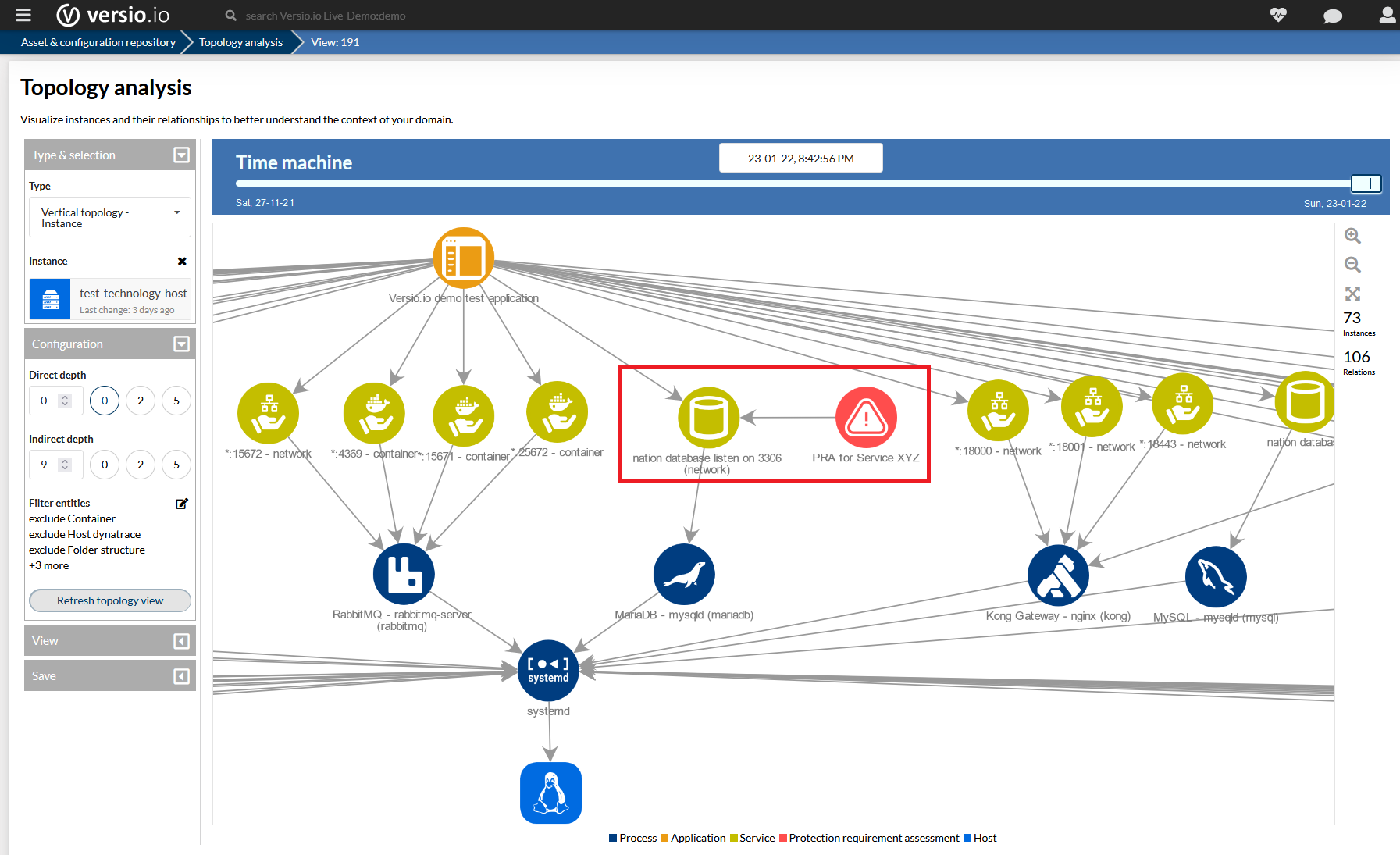
Protection requirement assessment
Which security measures are appropriate depends on the protection requirements of the information processed. Baden-Württemberg, Lower Saxony and Schleswig-Holstein explicitly link information security to the protection requirements; the other federal states do so via BSI IT-Grundschutz. In Versio.io, you record the protection requirements for confidentiality, integrity and availability of business processes and applications or import them from third-party systems. Versio.io automatically derives the protection requirements of every server, database and network component involved using inheritance rules such as the maximum principle – and updates them whenever the IT landscape changes.
Legal basis in the federal states:
- Baden-Württemberg - § 3(2) and (7) CSVO
- Berlin - § 23(1) EGovG Bln
- Hesse - § 3(1) HITSiG
- Mecklenburg-Western Pomerania - § 3(5) ISichG M-V
- Lower Saxony - § 13(1) NDIG
- Rhineland-Palatinate - § 17(1) EGovGRP; No. 3.2 NIS2 Administrative Regulation
- Saxony - § 4(1) SächsISichG
- Schleswig-Holstein - § 4(3) EGovG SH
- BSI - BSI Standard 200-2
Risk management

Risk management
Versio.io brings together outdated product versions, known vulnerabilities and configurations that violate your security guidelines as risks. Each risk is weighted according to its severity and the protection requirements of the affected component, so that you can prioritise measures in a comprehensible way. All corrective measures are tracked in an audit-proof manner – from detection to resolution.
Legal basis in the federal states:
- Baden-Württemberg - § 3(3) to (5) CSVO
- Bavaria - Art. 43(1) and Art. 49a(4) BayDiG
- Berlin - § 23(1) EGovG Bln
- Brandenburg - § 16(1) BbgEGovG
- Bremen - § 5 VV NIS2Ums FHB
- Hesse - § 3(1) HITSiG; No. 2 NIS2 Joint Decree
- Mecklenburg-Western Pomerania - § 3(1) and (2) no. 1 ISichG M-V
- Lower Saxony - § 13(1) NDIG; No. 4 NIS2UmsRdErl
- North Rhine-Westphalia - § 8 InfoSiG NRW
- Rhineland-Palatinate - § 17(1) EGovGRP; No. 3.2 NIS2 Administrative Regulation
- Saarland - § 3(1) IT-SiG SL
- Saxony - § 4(1) and (1a) no. 1 SächsISichG
- Schleswig-Holstein - § 4(3) EGovG SH
- NIS2 - Art. 21 NIS2 Directive
Vulnerability and end-of-life management

Vulnerability and end-of-life management
Versio.io continuously compares all detected software and hardware versions with an up-to-date CVE database and with the end-of-life dates of thousands of products. You are informed immediately when a new vulnerability affects your systems or when a product is no longer supported by the manufacturer – a risk that the explanatory memorandum to the ISichG M-V explicitly mentions alongside misconfigurations. Versio.io also recommends which versions you should switch to.
Legal basis in the federal states:
- Baden-Württemberg - § 3(5) no. 5 and § 7 CSVO
- Bavaria - Art. 49a(4) BayDiG
- Bremen - § 5(2) no. 5 and § 11 VV NIS2Ums FHB
- Hesse - No. 2.2(e) NIS2 Joint Decree
- Mecklenburg-Western Pomerania - § 3(2) no. 5 and § 9(1) no. 3 ISichG M-V
- Lower Saxony - Nos. 2.3(e) and 4.3(e) NIS2UmsRdErl
- North Rhine-Westphalia - § 8(2) no. 5 InfoSiG NRW
- Rhineland-Palatinate - No. 3.2 NIS2 Administrative Regulation
- Saxony - § 4(1a) no. 5 SächsISichG
- NIS2 - Art. 21(2)(e) NIS2 Directive
Change monitoring

Change monitoring
In Hesse and Saxony, significant changes to IT systems may only be made in consultation with the information security officer; in Mecklenburg-Western Pomerania, putting IT into operation and making significant changes require their agreement. Berlin obliges authorities to comply with the requirements of the central IT management when changing IT procedures. Versio.io automatically detects every change to hardware, software, configurations and user rights and historises it in an audit-proof manner. This allows you to compare actual changes with approved change requests and to identify unauthorised changes immediately.
Legal basis in the federal states:
- Berlin - § 20(3) EGovG Bln
- Hesse - § 3(4) HITSiG
- Mecklenburg-Western Pomerania - § 3(7) ISichG M-V
- Saxony - § 4(4) SächsISichG
- BSI - IT-Grundschutz module OPS.1.1.3
Policy monitoring and system hardening

Policy monitoring and system hardening
Almost all e-government laws oblige authorities to implement the binding IT security standards adopted by the IT Planning Council (IT-Planungsrat); several federal states also set their own binding minimum standards. Versio.io translates such requirements, your own security guidelines and recognised hardening benchmarks into rules and checks all configurations against them continuously – from TLS settings and certificates to open ports and application-specific parameters. Deviations are reported immediately and documented as risks.
Legal basis in the federal states:
- Baden-Württemberg - § 3(1) no. 3 CSG; § 4 CSVO
- Bavaria - Art. 46 BayDiG
- Berlin - § 20(2) no. 1 and § 21(2) nos. 4 and 16 EGovG Bln
- Brandenburg - § 12 BbgEGovG
- Bremen - § 16 EGovG BR
- Hesse - § 3(2) HITSiG
- Lower Saxony - § 15(3) NDIG
- Rhineland-Palatinate - § 17(2), § 26 and § 27(3) no. 2 EGovGRP
- Saarland - § 18 E-GovG SL
- Saxony - § 5(6) SächsISichG; § 12b(2) no. 3 and § 13 SächsEGovG
- Saxony-Anhalt - § 14 and § 22(1) no. 3 EGovG LSA
- Schleswig-Holstein - § 4(4) and § 9 EGovG SH
- Thuringia - § 26 ThürEGovG
Reporting obligations and incident handling

Reporting obligations and incident handling
Twelve federal states oblige their authorities to report security incidents. Where NIS2 has been implemented, the 24-hour deadline for the early warning leaves no time for lengthy research. Versio.io alerts you immediately to security-relevant events, creates tickets in your ITSM solution and shows which applications, services and organisational units are affected and what protection requirements they have. The complete history – from detection to resolution – is documented in an audit-proof manner and provides the facts for the notification and the final report to the state CERT or the competent authority.
Legal basis in the federal states:
- Baden-Württemberg - § 4(3) CSG; §§ 5 and 6 CSVO
- Bavaria - Art. 43(3) and Art. 49b BayDiG
- Berlin - § 23(2) EGovG Bln
- Brandenburg - § 16(2) BbgEGovG
- Bremen - § 8 VV NIS2Ums FHB
- Hesse - § 18 HITSiG; No. 5.1 NIS2 Joint Decree
- Mecklenburg-Western Pomerania - § 16 ISichG M-V
- Lower Saxony - § 14(2) NDIG; No. 6 NIS2UmsRdErl
- North Rhine-Westphalia - § 9 InfoSiG NRW
- Rhineland-Palatinate - § 17(3) EGovGRP; No. 3.2 nos. 5 and 6 NIS2 Administrative Regulation
- Saarland - § 3(2) IT-SiG SL
- Saxony - §§ 15 to 17 SächsISichG
- NIS2 - Art. 23 NIS2 Directive
Context for SOC and CERT

Context for SOC and CERT
Most federal states have created a legal basis for detecting attacks by evaluating log data; in Mecklenburg-Western Pomerania, every public body must also operate or join a security operations centre. To assess an alert, SOCs and CERTs need context: which system is affected, which software versions run on it, who is responsible for it and which services depend on it? Versio.io provides this information via its API. In addition, Versio.io detects unauthorised modifications to programs, libraries and configuration files by means of checksums.
Legal basis in the federal states:
- Baden-Württemberg - § 5(2) CSG
- Bavaria - Art. 44(2) BayDiG
- Berlin - § 23(3) EGovG Bln
- Brandenburg - § 16(3) to (6) BbgEGovG
- Hesse - §§ 8 and 9 HITSiG
- Mecklenburg-Western Pomerania - §§ 10 and 12 ISichG M-V
- Lower Saxony - § 19 NDIG
- North Rhine-Westphalia - § 6 InfoSiG NRW
- Rhineland-Palatinate - §§ 18 and 19 EGovGRP
- Saarland - §§ 4 and 5 IT-SiG SL
- Saxony - §§ 6, 12 and 13 SächsISichG
- Thuringia - § 32 ThürEGovG
Business continuity and backup monitoring

Business continuity and backup monitoring
All NIS2 implementations of the federal states require measures to maintain operations, such as backup management and recovery after an emergency. Versio.io monitors backup and batch job runs and documents their results. In the event of a disruption, the digital twin of your IT landscape remains available with the current and last known state of every component – an objective basis for root cause analysis and recovery.
Legal basis in the federal states:
- Baden-Württemberg - § 3(5) no. 3 CSVO
- Bavaria - Art. 49a(4) BayDiG
- Bremen - § 5(2) no. 3 VV NIS2Ums FHB
- Hesse - No. 2.2(c) NIS2 Joint Decree
- Mecklenburg-Western Pomerania - § 3(2) no. 3 ISichG M-V
- Lower Saxony - No. 4.3(c) NIS2UmsRdErl
- North Rhine-Westphalia - § 8(2) no. 3 InfoSiG NRW
- Rhineland-Palatinate - No. 3.2 no. 4 NIS2 Administrative Regulation
- Saxony - § 4(1a) no. 3 SächsISichG
- NIS2 - Art. 21(2)(c) NIS2 Directive
Audit-proof evidence and management reporting

Audit-proof evidence and management reporting
The management of an authority is responsible for information security – under the NIS2 implementations, it must approve the security measures and monitor their implementation – and supervisory authorities may request information, documents and evidence. Versio.io historises all inventory data, changes and risks in its temporal database. This allows you to show at any time what state a system was in on a given date, which vulnerabilities were known at that time and which measures were taken. Dashboards, metrics and PDF reports provide information security officers, management and supervisory authorities with the evidence they need – without additional manual effort.
Legal basis in the federal states:
- Baden-Württemberg - § 3(1) no. 3 CSG; § 3(8) and § 4 CSVO
- Bavaria - Art. 43(2), Art. 45(1) and Art. 49c(1) BayDiG
- Berlin - § 20(3) EGovG Bln
- Bremen - § 5(1), § 7 and § 12 VV NIS2Ums FHB
- Hesse - § 3(3) HITSiG; Nos. 2.6, 3 and 7 NIS2 Joint Decree
- Mecklenburg-Western Pomerania - § 3(2) no. 6, § 3(3) and (4) and § 17 ISichG M-V
- Lower Saxony - Nos. 4.1, 5 and 7 NIS2UmsRdErl
- North Rhine-Westphalia - § 8(2) no. 6, § 8(6) and § 12 InfoSiG NRW
- Rhineland-Palatinate - § 27(3) no. 2 EGovGRP; No. 3.2 no. 1 NIS2 Administrative Regulation
- Saxony - § 4(3) and § 5(7) SächsISichG
Digital sovereignty: on-premises or SaaS from Germany
Also relevant for municipalities and IT service providers
Further information
Read more

NIS2 - Efficient and prompt operational implementation
Meet NIS2 requirements article by article: risk management, incident handling, supply chain security and vulnerability management – automated with Versio.io

DORA - Efficient and prompt operational implementation
Implement DORA in IT operations: automated inventory, change monitoring, risk management and audit-proof documentation with Versio.io.

ISO 27001 - Efficient operational implementation
ISO 27001 explained: ISMS, CIA triad, certification process – and how Versio.io automates asset inventory, risk and policy monitoring for certification.

CRA - Efficient and prompt operational implementation
The EU Cyber Resilience Act (CRA) explained: SBOM, vulnerability handling, support period and reporting obligations - and how Versio.io supports manufacturers with CRA compliance.
Talk to us